English Grammar Rules for SSC Exam
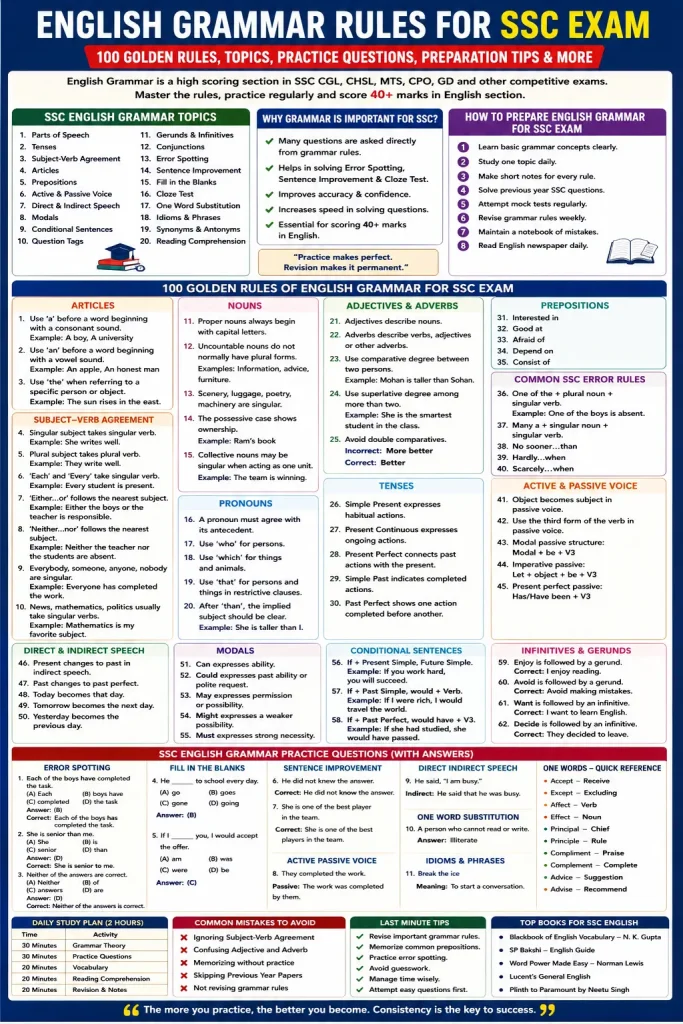
English is one of the highest-scoring sections in SSC examinations. Candidates preparing for SSC CGL, SSC CHSL, SSC MTS, SSC CPO, SSC GD, and Selection Post exams can improve their overall score significantly by mastering grammar.
Most SSC English questions are based on fixed grammar concepts. If you understand the rules and practice them regularly, you can solve Error Spotting, Sentence Improvement, Fill in the Blanks, Cloze Test, and Active-Passive Voice questions with confidence.
This comprehensive guide explains the most important English grammar rules for SSC exam preparation, along with examples and practical tips.
Why English Grammar Is Important for SSC Exams
Grammar forms the foundation of the English section. Every year, many questions directly or indirectly test grammar concepts.
Benefits of Strong Grammar Preparation
- Improves accuracy in error spotting.
- Helps solve sentence improvement questions quickly.
- Increases confidence in cloze tests.
- Supports reading comprehension.
- Enhances vocabulary usage.
A strong grammar foundation can save valuable time during the examination.
SSC English Grammar Topics
Candidates should prepare the following topics thoroughly.
1. Parts of Speech
- Noun
- Pronoun
- Verb
- Adjective
- Adverb
- Preposition
- Conjunction
- Interjection
2. Tenses
- Present Tense
- Past Tense
- Future Tense
3. Subject-Verb Agreement
4. Articles
5. Active and Passive Voice
6. Direct and Indirect Speech
7. Modals
8. Conditional Sentences
9. Question Tags
10. Prepositions
11. Error Spotting
12. Sentence Improvement
13. Fill in the Blanks
14. Cloze Test
15. Reading Comprehension
16. Synonyms and Antonyms
17. Idioms and Phrases
18. One Word Substitution
100 Golden Rules of English Grammar for SSC Exam
Daily routing for competitive exam
Articles
Rule 1
Use a before a word beginning with a consonant sound.
Example:
- A boy
- A university
Rule 2
Use an before a word beginning with a vowel sound.
Example:
- An apple
- An honest man
Rule 3
Use the when referring to a specific person or object.
Example:
- The sun rises in the east.
Subject-Verb Agreement
Rule 4
A singular subject takes a singular verb.
Example:
- She writes well.
Rule 5
A plural subject takes a plural verb.
Example:
- They write well.
Rule 6
Each and Every always take a singular verb.
Example:
- Every student is present.
Rule 7
Either…or follows the nearest subject.
Example:
- Either the teachers or the principal is attending.
Rule 8
Neither…nor follows the nearest subject.
Example:
- Neither the manager nor the workers are responsible.
Rule 9
Everybody, someone, anyone, nobody are singular.
Example:
- Everyone has completed the work.
Rule 10
News, mathematics, politics usually take singular verbs.
Example:
- Mathematics is my favorite subject.
Nouns
Rule 11
Proper nouns always begin with capital letters.
Rule 12
Uncountable nouns do not normally have plural forms.
Examples:
- Information
- Advice
- Furniture
Rule 13
Scenery, luggage, poetry, machinery are singular.
Rule 14
The possessive case shows ownership.
Example:
- Ram’s book
Rule 15
Collective nouns may be singular when acting as one unit.
Example:
- The team is winning.
Pronouns
Rule 16
A pronoun must agree with its antecedent.
Rule 17
Use “who” for persons.
Rule 18
Use “which” for things and animals.
Rule 19
Use “that” for persons and things in restrictive clauses.
Rule 20
After “than,” the implied subject should be clear.
Example:
- She is taller than I.
Adjectives and Adverbs
Rule 21
Adjectives describe nouns.
Rule 22
Adverbs describe verbs, adjectives, or other adverbs.
Rule 23
Use comparative degree between two persons.
Example:
- Mohan is taller than Sohan.
Rule 24
Use superlative degree among more than two.
Example:
- She is the smartest student.
Rule 25
Avoid double comparatives.
Incorrect:
- More better
Correct:
- Better
Tenses
Rule 26
Simple Present expresses habitual actions.
Rule 27
Present Continuous expresses ongoing actions.
Rule 28
Present Perfect connects past actions with the present.
Rule 29
Simple Past indicates completed actions.
Rule 30
Past Perfect shows one action completed before another.
Prepositions
Rule 31
Interested in
Rule 32
Good at
Rule 33
Afraid of
Rule 34
Depend on
Rule 35
Consist of
Common SSC Error Rules
Rule 36
One of the + plural noun + singular verb.
Example:
- One of the boys is absent.
Rule 37
Many a + singular noun + singular verb.
Rule 38
No sooner…than
Rule 39
Hardly…when
Rule 40
Scarcely…when
Active and Passive Voice
Rule 41
Object becomes subject in passive voice.
Rule 42
Use the third form of the verb in passive voice.
Rule 43
Modal passive structure:
Modal + be + V3
Rule 44
Imperative passive:
Let + object + be + V3
Rule 45
Present perfect passive:
Has/Have been + V3
Direct and Indirect Speech
Rule 46
Present changes to past in indirect speech.
Rule 47
Past changes to past perfect.
Rule 48
Today becomes that day.
Rule 49
Tomorrow becomes the next day.
Rule 50
Yesterday becomes the previous day.
How to Prepare English Grammar for SSC CGL
Step 1
Understand grammar concepts.
Step 2
Prepare one topic every day.
Step 3
Practice previous year questions.
Step 4
Take sectional mock tests.
Step 5
Revise important rules every week.
Step 6
Maintain a grammar notebook for mistakes.
Step 7
Read English newspapers and editorials.
Step 8
Practice error spotting daily.
Common Mistakes Made by SSC Aspirants
- Ignoring subject-verb agreement.
- Confusing adjective and adverb usage.
- Memorizing without practice.
- Skipping previous year papers.
- Not revising grammar rules.
Best Daily Study Plan
| Time | Activity |
|---|---|
| 30 Minutes | Grammar Theory |
| 30 Minutes | Practice Questions |
| 20 Minutes | Vocabulary |
| 20 Minutes | Reading Comprehension |
| 20 Minutes | Revision |
Frequently Asked Questions
Which grammar topics are most important for SSC?
Subject-Verb Agreement, Tenses, Articles, Prepositions, Voice, Narration, Error Spotting, and Sentence Improvement.
How many grammar questions come in SSC CGL?
The number varies by exam pattern, but grammar forms a major portion of the English section.
Is Class 10 grammar enough for SSC preparation?
It provides a strong base, but candidates should also practice advanced competitive-level questions.
How can I improve my English grammar for competitive exams?
Study rules, solve previous year papers, practice mock tests, and revise regularly.
Many aspirants find grammar and error spotting easier after sufficient practice.
Conclusion
English grammar is one of the highest-scoring areas in SSC examinations. Candidates who understand the rules and practice regularly can improve both speed and accuracy.
Consistent revision, topic-wise practice, and solving previous year papers are the keys to success. Whether you are preparing for SSC CGL, SSC CHSL, SSC MTS, SSC CPO, or any other competitive examination, a strong command of grammar will give you a significant advantage.
most searches keywords here >english grammar rules pdf for ssc cgl,
“english grammar rules for ssc exams,
“english grammar rules for ssc cgl,
“english grammar rules for ssc mts,
“ssc grammar rules pdf,
“ssc english grammar rules pdf,
“ssc english rules pdf,English Grammar Rules for SSC Exam,English Grammar Rules for SSC Exam,English Grammar Rules for SSC Exam,English Grammar Rules for SSC Exam,English Grammar Rules for SSC Exam,English Grammar Rules for SSC Exam