How to Crack UPSC Without Coaching in India – Complete Self-Study Guide
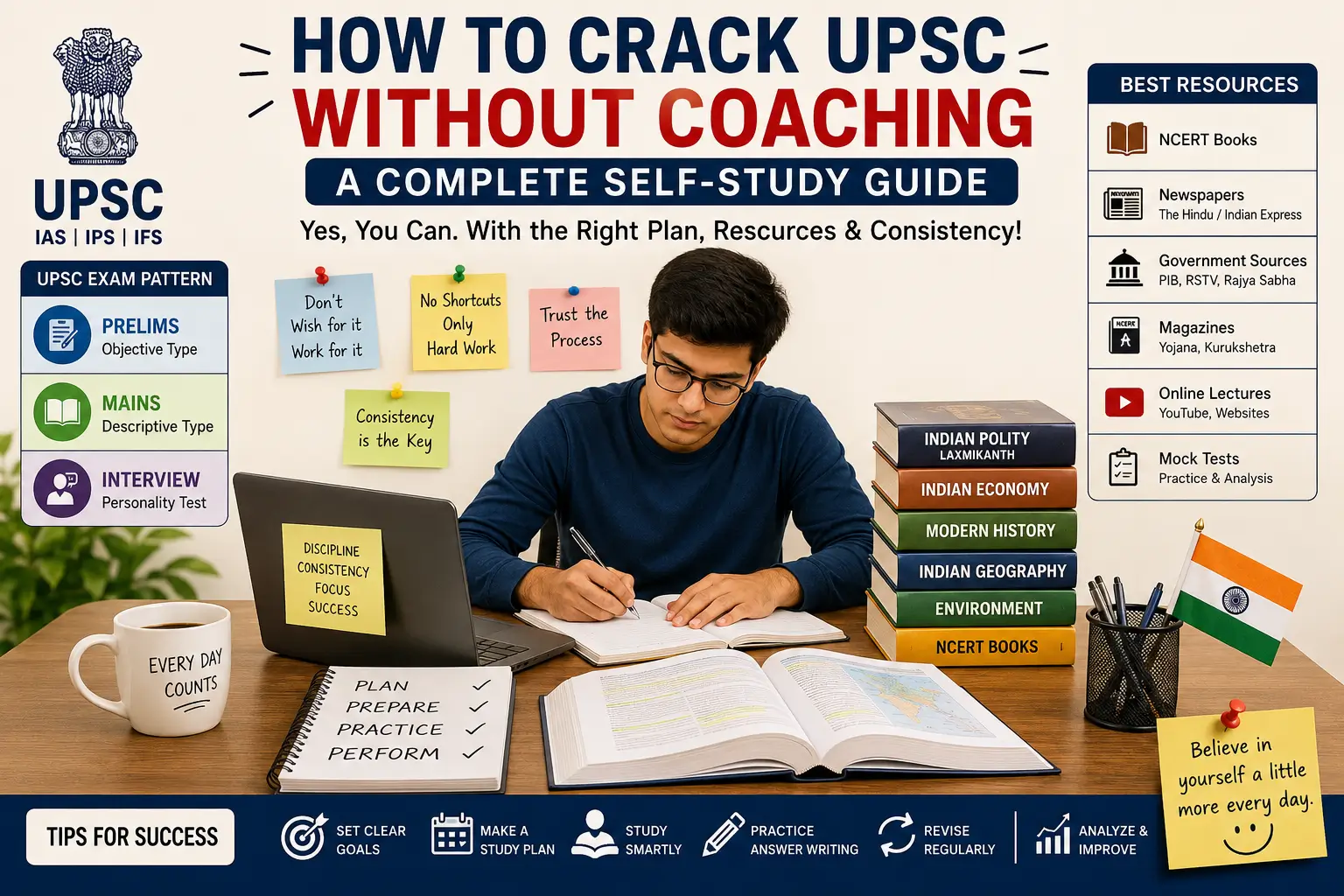
The dream of becoming an IAS, IPS, or IFS officer inspires millions of young Indians every year. Yet one question keeps appearing across Google, Quora, Reddit, and UPSC discussion forums: How to crack UPSC without coaching in India? The good news is that thousands of candidates have successfully cleared the Civil Services Examination through self-study, discipline, and smart planning. Coaching institutes can provide guidance, but they are not mandatory for success.
The UPSC Civil Services Examination is designed to test knowledge, analytical thinking, decision-making ability, communication skills, and personality. These qualities cannot be purchased through expensive coaching programs. They are developed through consistent effort, structured learning, and regular revision. In recent years, digital resources, online lectures, government reports, and free study materials have made UPSC preparation more accessible than ever before.
Current UPSC data shows the extreme competitiveness of the examination. During the UPSC CSE 2025 cycle, over 9.37 lakh candidates applied, around 5.76 lakh appeared for the preliminary examination, and only 958 candidates were finally recommended for appointment. This means success requires strategy rather than simply studying harder.
If you are wondering how can I crack UPSC without coaching, this detailed guide will help you understand the complete roadmap.
Understanding the UPSC Exam Structure
Prelims, Mains, and Interview Explained
Before preparing for UPSC, it is essential to understand the examination structure. Many aspirants start studying without knowing what the exam actually demands. This often results in wasted effort and confusion.
The UPSC Civil Services Examination consists of three stages:
| Stage | Purpose |
|---|---|
| Preliminary Examination | Screening Test |
| Main Examination | Written Descriptive Exam |
| Personality Test | Interview Assessment |
The Preliminary Examination contains objective questions from General Studies and CSAT. Candidates who qualify move to the Mains stage. The Mains examination consists of descriptive papers that evaluate analytical ability, writing skills, and subject knowledge. Finally, candidates appear for the Personality Test, where their overall suitability for civil services is assessed.
The most important thing to remember is that UPSC is not a memory contest. It rewards understanding, application, and critical thinking. A self-study candidate can compete equally with coaching students if they focus on conceptual clarity.
Why UPSC Is Considered One of India’s Toughest Exams
UPSC is challenging because of its vast syllabus, unpredictable question patterns, and low selection ratio. According to official result statistics, only 958 candidates were recommended after multiple stages of evaluation in the 2025 examination cycle.
The challenge is not merely academic. Aspirants must remain consistent for one to three years while balancing motivation, revision, current affairs, and answer writing. Many candidates underestimate the psychological aspect of preparation. UPSC is often compared to a marathon rather than a sprint. Those who maintain consistency eventually outperform candidates who rely only on short bursts of motivation.
Understanding this reality helps aspirants create realistic expectations. Success comes from systematic progress rather than overnight transformation.
Can You Really Crack UPSC Without Coaching?
Success Stories of Toppers Who Cleared IAS Without Coaching
One of the biggest misconceptions among aspirants is that coaching is compulsory. In reality, many successful candidates have cleared UPSC through self-study. Every year, numerous rank holders openly share that they relied primarily on standard books, online resources, newspapers, and self-made notes.
The rise of digital education has transformed UPSC preparation. Aspirants now have access to free lectures, government reports, PIB releases, parliamentary debates, economic surveys, and mock tests. What was once available only inside coaching classrooms is now available online.
The key lesson from successful self-study candidates is not that they studied differently. It is that they studied consistently. They focused on understanding concepts, revising repeatedly, and practicing answer writing. Instead of collecting hundreds of books, they mastered a limited set of resources.
Common Myths About UPSC Preparation
How to Crack UPSC Without Coaching in India 2026
Several myths discourage students from preparing independently.
Myth 1: Coaching guarantees success.
The reality is that coaching provides guidance but cannot guarantee selection.
Myth 2: Expensive study material is necessary.
Most toppers rely on NCERT books, standard reference books, and current affairs sources.
Myth 3: UPSC can only be cracked from Delhi.
The internet has eliminated geographical barriers. Aspirants from villages, small towns, and remote regions now compete successfully.
Myth 4: First-attempt success is impossible.
While difficult, first-attempt success is achievable with proper planning and disciplined execution.
How to Crack UPSC Without Any Coaching
Building the Right Mindset
Your mindset determines your preparation quality. UPSC preparation often feels overwhelming because of the syllabus size. Instead of viewing the syllabus as a mountain, break it into manageable sections.
Think like an athlete preparing for a championship. Daily progress matters more than occasional brilliance. A candidate studying six focused hours daily for a year will usually outperform someone studying randomly for twelve hours.
Developing patience is equally important. According to UPSC annual report data, only about 6% of successful candidates clear the examination in their first attempt, while many succeed after multiple attempts. This shows that persistence often matters more than initial talent.
Creating a Practical Study Plan
A study plan provides direction. Without one, aspirants often spend months feeling busy without making meaningful progress.
A practical UPSC self-study plan includes:
- Complete NCERT books first.
- Cover standard reference books.
- Read current affairs daily.
- Practice answer writing regularly.
- Take mock tests.
- Revise continuously.
Divide your day into focused study blocks. Allocate time for static subjects, current affairs, revision, and answer writing. Weekly and monthly targets help maintain accountability.
The objective is not to study longer but to study smarter.
Best Resources for UPSC Self-Study
NCERT Books Strategy,How to Crack UPSC Without Coaching in India 2026
NCERT books form the foundation of UPSC preparation. They simplify complex concepts and build conceptual clarity.
Focus particularly on:
- History
- Geography
- Economics
- Political Science
- Sociology
- Science
Reading NCERTs multiple times is more valuable than reading dozens of advanced books once.
Standard Reference Books
After completing NCERTs, move to standard resources.
| Subject | Recommended Book |
|---|---|
| Polity | Laxmikanth |
| Modern History | Spectrum |
| Geography | GC Leong |
| Economy | Basic Economy Resources |
| Environment | Standard Environment Sources |
Avoid resource overload. One book revised five times is better than five books read once.
Free Online Resources
Modern UPSC preparation has become highly accessible.
Useful resources include:
- PIB releases
- Government websites
- Yojana Magazine
- Kurukshetra Magazine
- Rajya Sabha TV discussions
- Parliament debates
- Economic Survey
- Union Budget documents
These sources provide authentic information directly from official institutions.
How to Crack UPSC in First Attempt Without Coaching
Time Management Techniques
First-attempt success requires strategic preparation. The biggest advantage first-attempt candidates have is freshness and enthusiasm.
Create a yearly roadmap:
| Phase | Duration |
|---|---|
| Foundation Building | 4 Months |
| Advanced Study | 4 Months |
| Revision & Tests | 3 Months |
| Final Revision | 1 Month |
Avoid perfectionism. Many aspirants waste months trying to complete one subject perfectly while neglecting others. UPSC rewards balanced preparation.
Answer Writing Practice
Answer writing separates successful candidates from unsuccessful ones.
Knowledge alone does not secure marks. You must present information clearly and effectively.
Practice:
- Introduction
- Body
- Conclusion
- Diagrams
- Flowcharts
- Examples
- Current affairs integration
Writing daily answers improves speed, structure, and confidence.
Subject-Wise Preparation Strategy
How to Crack UPSC Without Coaching in India 2026
General Studies
General Studies forms the backbone of UPSC preparation. Since it appears across Prelims and Mains, candidates should prioritize it.
Focus on:
- Indian Polity
- Governance
- Economy
- Geography
- History
- Environment
- Science & Technology
- International Relations
Integrate current affairs with static concepts. This improves analytical understanding and answer quality.
Current Affairs
Current affairs should be studied daily rather than accumulated monthly.
Read one reliable newspaper consistently. Make concise notes focusing on:
- Government schemes
- International developments
- Economy
- Environment
- Social issues
- Science and technology
Current affairs become powerful when linked with syllabus topics.
Optional Subject Selection
Choosing the right optional subject significantly impacts your rank.
Select an optional based on:
- Interest
- Graduation background
- Availability of resources
- Syllabus length
- Previous performance
Avoid selecting subjects merely because others recommend them.
UPSC Preparation After 12th
Long-Term Roadmap for Beginners
Students frequently search for How to crack UPSC after 12th. Starting early provides a major advantage.
A suggested roadmap:
Year 1
- Build reading habits
- Improve English communication
- Read NCERT books
Year 2
- Start current affairs
- Learn answer writing
Year 3
- Complete core UPSC syllabus
- Select optional subject
Final Year
- Begin full UPSC-focused preparation
Early preparation creates a strong foundation without unnecessary pressure.
Mistakes to Avoid During Self-Preparation
Self-study candidates often repeat predictable mistakes.
The biggest mistakes include:
- Collecting too many books
- Ignoring revision
- Skipping answer writing
- Neglecting current affairs
- Comparing yourself constantly with others
- Following multiple strategies simultaneously
Many aspirants spend more time planning than studying. A simple plan executed consistently is more effective than a perfect plan never implemented.
Reddit and UPSC discussion communities repeatedly highlight that consistency beats complexity. Aspirants who follow limited resources and revise thoroughly often perform better than those chasing every new study material release.
Conclusion
If you are asking how to clear UPSC without coaching, the answer is straightforward: focus on self-discipline, smart planning, quality resources, and continuous revision. Coaching can guide you, but it cannot replace determination, consistency, and hard work.
The modern aspirant has access to an unprecedented amount of free educational content. With NCERT books, standard references, online lectures, government publications, current affairs analysis, and mock tests, everything required to crack UPSC is available at your fingertips.
The journey may be challenging, but countless aspirants have proven that success is possible through self-study. Whether your goal is to crack UPSC in your first attempt or build a long-term strategy, the principles remain the same: understand the syllabus, master the basics, revise relentlessly, and believe in your preparation.
FAQs,How to Crack UPSC Without Coaching in India 2026
1. Can I crack UPSC without coaching?
Yes. Thousands of candidates have cleared UPSC through self-study using standard books, online resources, mock tests, and disciplined preparation.
2. How many hours should I study daily for UPSC?
Most successful aspirants study between 6 and 10 productive hours daily. Consistency matters more than extreme study hours.
3. Which books are enough for UPSC self-study?
NCERT books, Laxmikanth for Polity, Spectrum for History, Geography resources, Economic Survey, and current affairs sources are generally sufficient.
4. Is UPSC first attempt possible without coaching?
Yes. While challenging, many candidates clear UPSC in their first attempt through structured preparation and rigorous revision.
5. Can I start UPSC preparation after 12th?
Absolutely. Starting after 12th allows you to build strong fundamentals, reading habits, and conceptual understanding long before appearing for the examination.