Daily Routine for Government Exam Preparation
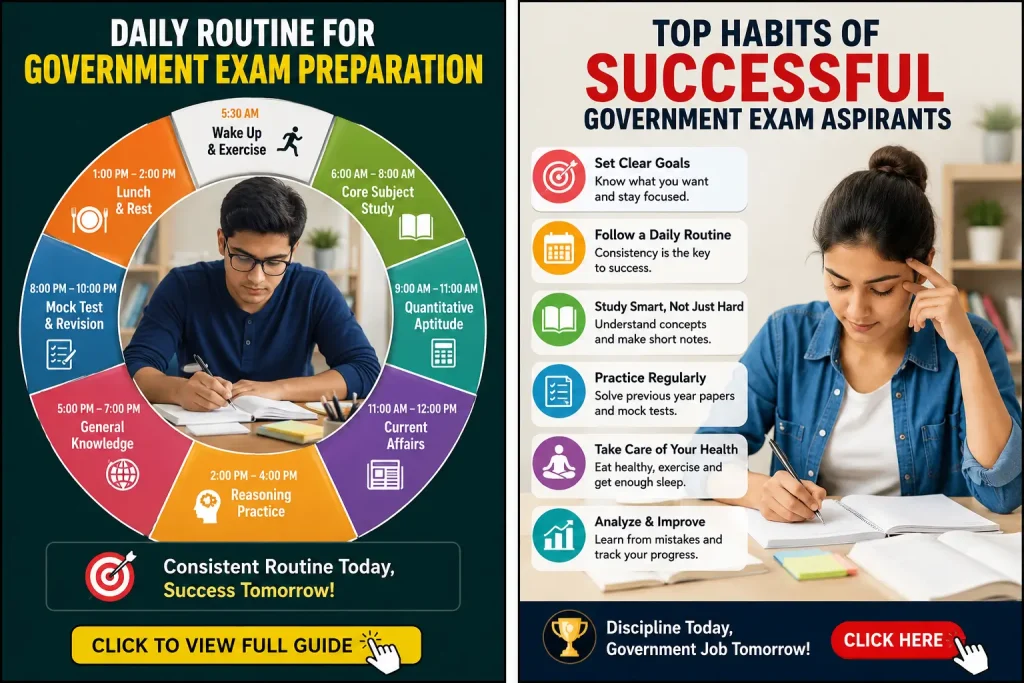
Government exams remain one of the most competitive career paths in India. Every year, lakhs of candidates compete for a limited number of vacancies in examinations such as UPSC, SSC, Banking, Railways, State PSC, Defence, and other government recruitment tests. Daily Routine for Government Exam Preparation 2026 Recent UPSC statistics show that over 8.19 lakh candidates registered for the Civil Services Preliminary Examination 2026, while approximately 5.49 lakh candidates actually appeared for the exam. Despite such huge participation, fewer than a thousand candidates eventually secure top civil service positions. These numbers clearly demonstrate why a structured daily routine is not optional—it is essential for success.
Many aspirants begin their preparation with enthusiasm but gradually lose momentum because they do not have a fixed schedule. A government exam preparation journey is similar to running a marathon rather than a sprint. Motivation may help you start, but discipline helps you finish. Candidates who consistently follow a practical routine often outperform highly talented aspirants who study without planning. The goal is not simply to study for long hours; the goal is to study efficiently every day.
A well-designed routine helps improve concentration, retention, revision frequency, and exam temperament. It also reduces stress because you know exactly what needs to be done each day. Whether you are preparing for UPSC, SSC CGL, Banking, Railway, Police, Teaching, or State Government exams, creating and following a systematic daily routine can dramatically improve your chances of success.
Why a Daily Routine Matters for Government Exam Aspirants
Success in competitive examinations is largely determined by consistency. Most aspirants underestimate how much progress can be achieved through small daily improvements. Imagine improving by just one percent every day. Over several months, those small gains compound into substantial knowledge and confidence. This is exactly how toppers prepare. They do not rely on sudden bursts of motivation. Instead, they follow disciplined systems.
A daily routine creates structure in your preparation journey. Without structure, candidates often spend too much time on favorite subjects while neglecting weak areas. A routine ensures balanced preparation across all subjects. It prevents procrastination and minimizes decision fatigue because you no longer waste time wondering what to study next.
Another advantage is stress reduction. Competitive exams are mentally demanding. A planned schedule helps you manage workload effectively and prevents last-minute panic. When your preparation is divided into manageable daily tasks, even large syllabi begin to feel achievable. The confidence that comes from completing daily targets consistently can significantly improve your overall performance.
The Science Behind Consistency
Educational psychologists frequently emphasize that spaced repetition and regular revision improve long-term memory retention. Studying a subject repeatedly over multiple sessions produces better results than studying it intensively for a single day. This is why successful aspirants revise continuously rather than waiting until the final weeks before the exam.
Recent insights from successful UPSC toppers also highlight discipline over motivation. AIR 1 Anuj Agnihotri emphasized that consistent habits and disciplined study routines contribute more to success than temporary motivational boosts. This lesson applies to every government examination aspirant regardless of the exam category.
Understanding the Competition in Government Exams
Before creating a study routine, it is important to understand the scale of competition. Government jobs offer stability, attractive salaries, social prestige, career growth, pensions, and other benefits. As a result, competition continues to increase every year. According to recent official examination data, more than 8 lakh candidates registered for UPSC Civil Services Prelims 2026, while approximately 5.49 lakh appeared across 83 cities in India.
The reality of this competition should not discourage you. Instead, it should motivate you to prepare strategically. Many candidates fail not because they lack intelligence but because they lack consistency, proper planning, and regular revision. Government examinations reward disciplined preparation much more than raw talent.
The modern examination pattern has also evolved significantly. Questions increasingly test conceptual understanding, analytical ability, and application-based thinking. Simply memorizing facts is no longer enough. Candidates must develop comprehension skills, problem-solving abilities, and decision-making capabilities. A structured daily routine helps cultivate these qualities over time.
Setting Realistic Goals Before Creating a Routine
A common mistake among aspirants is creating unrealistic schedules. Some students plan to study 14 or 16 hours daily from the beginning. Such schedules rarely last longer than a few days. Sustainable preparation requires realistic planning based on your current circumstances, energy levels, and responsibilities.
Start by defining long-term and short-term goals. Long-term goals might include completing the syllabus within six months or achieving a target score in mock tests. Short-term goals should focus on daily and weekly achievements such as completing specific chapters, revising current affairs, or solving practice questions.
Your routine should also account for personal responsibilities. A college student, full-time employee, and full-time aspirant will naturally require different schedules. The ideal routine is the one you can follow consistently for months, not just a few days. Remember, consistency beats intensity when it comes to competitive exam preparation.
Ideal Morning Routine for Government Exam Preparation
The morning hours are often considered the most productive period for studying. The mind is refreshed after sleep, distractions are minimal, and concentration levels tend to be higher. A productive morning routine can set the tone for the entire day.
Try waking up between 5:00 AM and 6:00 AM. Begin with hydration and light physical activity. Even a 20-minute walk, stretching session, or yoga practice can improve blood circulation and mental alertness. Many successful candidates also include meditation or breathing exercises in their morning routine because these activities improve focus and reduce anxiety.
After exercising, spend the first study session on difficult subjects. Your brain’s cognitive performance is strongest during the early hours. Subjects such as mathematics, reasoning, economics, polity, or science can be studied more effectively during this period. Avoid checking social media immediately after waking up, as it can reduce productivity and disrupt concentration.
Best Study Schedule for Government Exams
A balanced study schedule should cover all major sections of your examination while also allowing adequate revision time. Below is an example schedule that many aspirants can customize according to their needs.
| Time | Activity |
|---|---|
| 5:30 AM – 6:00 AM | Wake Up and Exercise |
| 6:00 AM – 8:00 AM | Core Subject Study |
| 8:00 AM – 9:00 AM | Breakfast and Break |
| 9:00 AM – 11:00 AM | Quantitative Aptitude |
| 11:00 AM – 12:00 PM | Current Affairs |
| 12:00 PM – 1:00 PM | Revision |
| 1:00 PM – 2:00 PM | Lunch and Rest |
| 2:00 PM – 4:00 PM | Reasoning Practice |
| 4:00 PM – 5:00 PM | Break |
| 5:00 PM – 7:00 PM | General Knowledge |
| 7:00 PM – 8:00 PM | Dinner |
| 8:00 PM – 10:00 PM | Mock Tests or Revision |
Current Affairs Session
Current affairs play a critical role in many government examinations. Instead of spending several hours reading newspapers, focus on quality over quantity. Allocate 45–60 minutes daily for current affairs. Maintain concise notes that can be revised regularly. Weekly revision is essential because current affairs accumulate rapidly.
Quantitative Aptitude Session
Quantitative aptitude requires regular practice. Mathematical skills improve through repetition and exposure to different question types. Solve problems daily rather than studying formulas alone. Speed and accuracy should develop together because most competitive examinations involve strict time limits.
Reasoning Practice Session
Reasoning tests logical thinking and pattern recognition. Daily exposure helps improve problem-solving speed. Focus on puzzles, seating arrangements, coding-decoding, syllogisms, and analytical reasoning. Gradual improvement is more valuable than attempting difficult questions prematurely.
General Knowledge Revision
General knowledge preparation should include static GK, history, geography, polity, economics, and science. Continuous revision is crucial because information retention declines if knowledge is not revisited regularly.
Time Management Strategies
Time management is often the difference between average performers and toppers. One of the most effective techniques is the Pomodoro Method. Study intensely for 25 to 50 minutes, followed by a short break. This approach prevents mental fatigue while maintaining productivity throughout the day.
Another useful strategy is task prioritization. Complete high-value activities first. Difficult topics should be studied during peak energy periods, while lighter tasks can be scheduled later. Track your progress daily and adjust your routine based on performance rather than assumptions.
Avoid multitasking. Studying while checking messages or social media reduces efficiency significantly. Deep, focused work produces better results than long hours of distracted studying.
Importance of Mock Tests
Mock tests are among the most important components of exam preparation. Many aspirants spend months studying but avoid testing themselves. This is a serious mistake because examination success depends not only on knowledge but also on application under pressure.
Weekly mock tests help identify strengths and weaknesses. They reveal gaps in understanding and highlight areas requiring additional attention. Mock tests also improve time management, decision-making, and confidence.
Weekly Performance Analysis
Simply taking mock tests is not enough. Analyze every test carefully. Review incorrect answers, identify recurring mistakes, and create an improvement plan. Many toppers spend almost as much time analyzing tests as they do taking them. This process transforms mistakes into learning opportunities.
Common Mistakes to Avoid
Many aspirants unknowingly sabotage their preparation through avoidable mistakes. One common error is studying excessively without breaks. Overstudying leads to burnout, reduced retention, and declining motivation. Quality always matters more than quantity.
Another mistake is neglecting physical and mental health. Competitive preparation can be stressful, but ignoring sleep, nutrition, and exercise eventually affects performance. Your brain functions best when your body is healthy.
Many students also collect too many study materials. One book revised multiple times is usually more valuable than ten books read once. Focus on mastering selected resources instead of constantly searching for new materials.
Daily Routine for Working Professionals
Working professionals face unique challenges because they must balance employment and preparation. The key is maximizing available time rather than comparing yourself with full-time aspirants.
A practical schedule might include two to three study hours before work and two to three hours after work. Weekends should be used for mock tests, revision, and completing pending topics. Consistency becomes even more important because available study time is limited.
Smart planning can compensate for fewer study hours. Focus on high-yield topics, maintain concise notes, and utilize travel time for current affairs revision whenever possible.
Daily Routine for College Students
College students have an advantage because they can begin preparation early. A balanced schedule allows academic responsibilities and competitive exam preparation to coexist effectively.
Students can dedicate early mornings and evenings to exam preparation while attending classes during the day. Holidays and weekends provide excellent opportunities for mock tests and extended study sessions. Early preparation also reduces pressure later because foundational concepts are developed gradually.
College years are an ideal time to build reading habits, improve communication skills, and strengthen analytical thinking. These skills benefit almost every government examination.
Recommended Study Resources
Selecting the right resources is crucial. Limit your materials and focus on mastering them thoroughly.
Recommended resources generally include:
- Standard textbooks for core subjects
- Daily newspaper reading
- Monthly current affairs magazines
- Previous year question papers
- Quality mock test series
- Government reports and official sources where relevant
Always prioritize revision over collecting additional resources. Knowledge becomes valuable only when it can be recalled accurately during the examination.
Why a Daily Study Routine Is Non-Negotiable
Examinations like RPSC RAS, REET, and Rajasthan Police demand comprehensive command over subjects spanning General Knowledge, Current Affairs, Reasoning, Quantitative Aptitude, and Rajasthan-specific content. A disciplined routine ensures you traverse the syllabus systematically, consolidate retention, and cultivate genuine confidence. Without structure, even the most industrious aspirant risks squandering precious preparation time.
Do you also searches on google many times no need to worry about your information in this article you get all informaton here some keywrods>daily routine for government exam preparation,
“daily routine for government exam preparation pdf download,
“daily routine for government exam preparation pdf,
“daily routine for government exam preparation ppt,
“8 hours study time table for competitive exams,
“12 hours study time table for competitive exams,
“timetable for competitive exam preparation pdf,
“24 hour daily routine for students,
“best study plan for competitive exams,
The Ultimate Daily Study Routine for Competitive Exam Success,Daily Routine for Government Exam Preparation 2026
1. Start Your Day with Purposeful Planning — 6:00 AM to 6:30 AM
Commence each morning by delineating clear, achievable objectives. Invest thirty minutes reviewing your overarching study plan and prioritizing topics aligned with the official Rajasthan government exam syllabus. Draw on Apni Padhai Publication resources to pinpoint high-weightage areas such as Rajasthan History, Geography, and Current Affairs.
Practical Tip: Draft a focused to-do list. For instance, earmark time specifically for revising Rajasthan Culture or solving fifty Reasoning questions. Intentional planning dismantles procrastination and sustains sharp mental focus throughout the day.
2. Morning Study Block: Core Subjects — 6:30 AM to 9:30 AM
The early hours represent your cognitive prime. Reserve this three-hour bloc for intellectually demanding subjects — Quantitative Aptitude, Reasoning, or General Science. For Rajasthan-specific examinations, direct substantial attention toward the state’s Economy and Art and Culture.
Strategy:
- Devote the first ninety minutes to theoretical study, such as working through chapters in Apni Padhai Publication’s Rajasthan GK Book
- Allocate the remaining ninety minutes to practice questions and previous years’ papers
Pro Tip: Segment this bloc into fifty-minute study intervals punctuated by ten-minute recuperative breaks. This cadence preserves cognitive acuity and prevents mental fatigue.
3. Mid-Morning: Current Affairs and General Knowledge — 9:30 AM to 11:00 AM
Current Affairs constitutes a pivotal pillar of Rajasthan government examinations. Dedicate ninety minutes to reading established newspapers — The Hindu or Rajasthan Patrika — and synthesizing key developments pertaining to Rajasthan, national affairs, and global events.
Resources to Leverage:
- Apni Padhai Publication’s comprehensive GK books
- Credible online portals and our website’s blog section, which features daily GK quizzes for continuous reinforcement
4. Lunch and Deliberate Relaxation — 11:00 AM to 12:00 PM
Allow yourself a genuine respite. Eschew heavy meals that induce postprandial lethargy. A brisk walk or light stretching reactivates your energy reserves and primes your mind for the afternoon’s academic demands.
5. Afternoon Study Block: Language and Optional Subjects — 12:00 PM to 3:00 PM
Redirect your focus toward Hindi, English, or optional subjects such as Public Administration or History, contingent on your specific examination. Rajasthan government exams rigorously assess linguistic proficiency, making regular practice in comprehension, grammar, and vocabulary indispensable.
How to Study:
- Solve twenty to thirty comprehension or grammar questions from Apni Padhai Publication’s Language Guide
- Revise Rajasthan-specific terminology and bilingual phrasing relevant to dual-language papers
Afternoon sessions are ideally suited for these comparatively lighter subjects, sustaining your preparatory momentum without overtaxing cognition.
6. Evening Revision and Mock Tests — 3:30 PM to 6:30 PM
This pivotal three-hour window bridges theory with exam-readiness. Revisit the morning’s material, then immerse yourself in mock tests that authentically simulate real examination conditions.
Action Plan:
- Attempt a sectional test — Reasoning or Rajasthan GK — via Apni Padhai Publication’s Online Course Platform
- Dedicate a full hour to scrutinizing errors and methodically revisiting underperforming topics
This reflective practice is where genuine proficiency is forged.
7. Night: Light Revision and Forward Planning — 8:00 PM to 9:30 PM
Conclude the academic day with gentle revision of formulae, salient facts, or concise notes. Abstain from intensive study during these hours to safeguard sleep quality. Simultaneously, sketch the following day’s schedule to preserve organizational momentum.
Tip: Employ Apni Padhai Publication’s Quick Revision Notes for succinct summaries spanning Rajasthan History, Geography, and Polity — ideal for effortless nocturnal reinforcement.
8. Self-Care and Restorative Sleep — 10:00 PM Onwards
Adequate sleep — seven to eight hours — is genuinely non-negotiable and not a luxury. A well-rested mind consolidates learned material with demonstrably greater efficacy and sharpens problem-solving acuity. Treat sleep as a strategic asset, not an afterthought.
Conclusion
A successful government exam journey begins with a realistic and disciplined daily routine. While competition continues to grow every year, opportunities remain available for candidates who prepare strategically. Consistency, revision, mock tests, and effective time management are the pillars of success.
The most important lesson is simple: do not wait for perfect conditions. Start with the resources and time available today. Build productive habits, follow your routine consistently, and improve gradually. Every chapter completed, every mock test analyzed, and every day of disciplined preparation brings you closer to your goal. Government exam success is rarely achieved through sudden brilliance—it is earned through thousands of disciplined decisions made every single day.
FAQs
1. How many hours should I study daily for government exams?
Most aspirants benefit from 6–10 focused hours daily. Quality and consistency matter more than total study hours.
2. Is waking up early necessary for government exam preparation?
Not necessarily. Study during your most productive hours, although many aspirants find mornings highly effective.
3. How often should I take mock tests?
At least one full-length mock test per week is recommended, increasing frequency as the exam approaches.
4. Can I crack government exams while working full-time?
Yes. Many successful candidates prepare alongside employment through disciplined scheduling and efficient study methods.
5. What is the biggest mistake government exam aspirants make?
Lack of revision is one of the most common reasons for poor performance despite extensive study.
most searches keywords list is here >daily routine for government exam preparation,
“daily routine for government exam preparation pdf download,
“daily routine for government exam preparation pdf,
“daily routine for government exam preparation ppt,
“8 hours study time table for competitive exams,
“12 hours study time table for competitive exams,
“timetable for competitive exam preparation pdf,
“24 hour daily routine for students,
“best study plan for competitive exams,Daily Routine for Government Exam Preparation 2026,Daily Routine for Government Exam Preparation 2026,Daily Routine for Government Exam Preparation 2026,Daily Routine for Government Exam Preparation 2026,Daily Routine for Government Exam Preparation 2026,Daily Routine for Government Exam Preparation 2026,Daily Routine for Government Exam Preparation 2026,Daily Routine for Government Exam Preparation 2026,Daily Routine for Government Exam Preparation 2026,Daily Routine for Government Exam Preparation 2026,Daily Routine for Government Exam Preparation 2026,Daily Routine for Government Exam Preparation 2026,Daily Routine for Government Exam Preparation 2026,Daily Routine for Government Exam Preparation 2026,Daily Routine for Government Exam Preparation 2026