RRB NTPC Preparation Tips for Beginners: A Complete Guide to Your Railway Dream
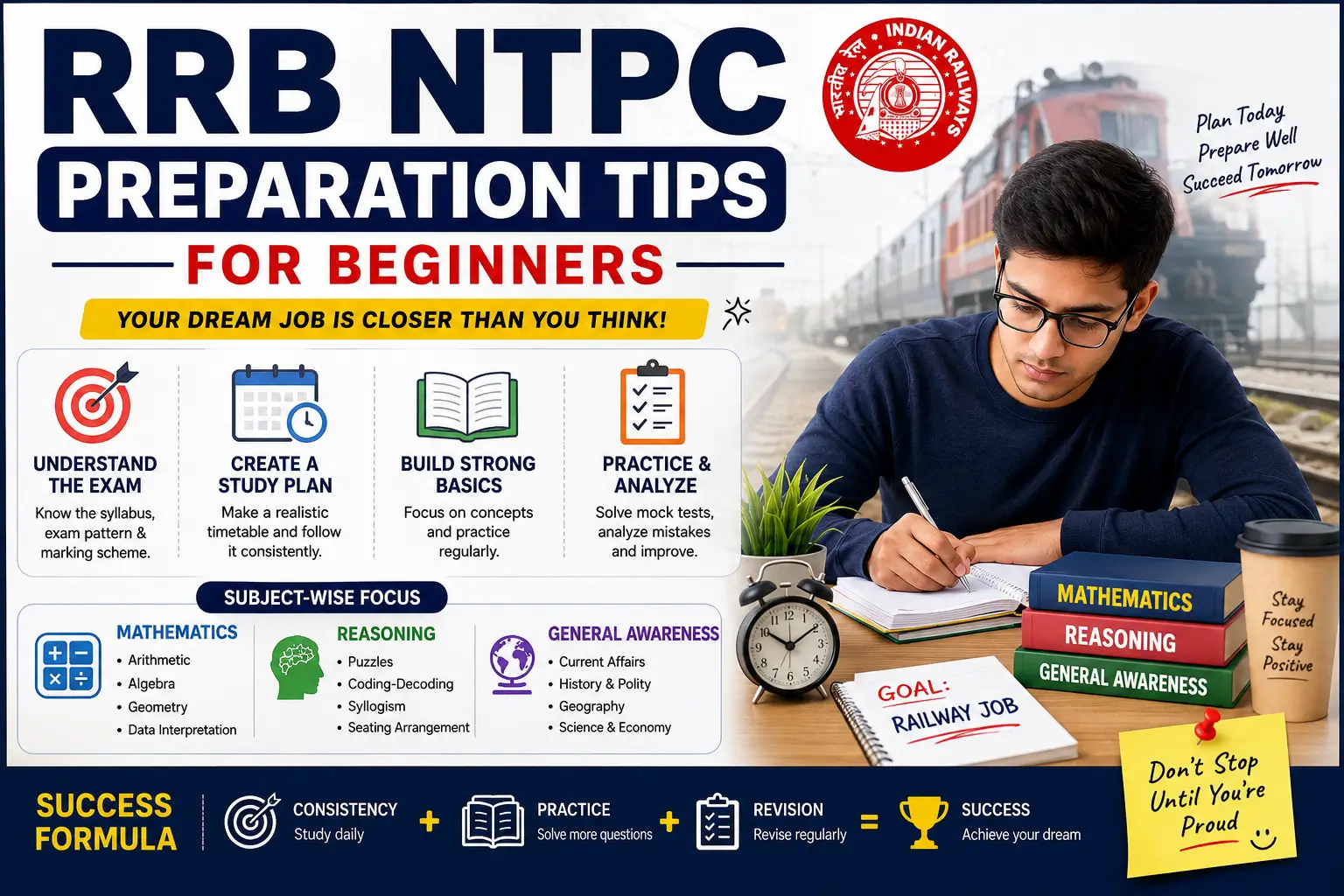
Every year, millions of students fill out the RRB NTPC application form with one simple dream—to secure a stable government job and give their family a better future.
Some are college students. Some are preparing while working a full-time job. Others have already faced failures in competitive exams and are trying one more time.
If you are a beginner, you may feel confused.
- Which books should I buy?
- How many hours should I study?
- I
- Can I crack RRB NTPC in my first attempt?
The answer is YES.
Thousands of candidates clear the exam every year with a smart strategy, discipline, and consistent practice. This complete RRB NTPC preparation guide will help you understand exactly where to start.
What is RRB NTPC?
RRB NTPC Preparation Tips for Beginners
RRB NTPC stands for Railway Recruitment Board Non-Technical Popular Categories. It is one of India’s most popular government job examinations.
The exam recruits candidates for posts such as:
- Station Master
- Goods Train Manager
- Junior Clerk
- Accounts Clerk
- Senior Commercial cum Ticket Clerk
- Traffic Assistant
The competition is high, but a planned approach can significantly improve your chances.
RRB NTPC Preparation Strategy for Beginners,RRB NTPC Preparation Tips for Beginners
Many beginners make one common mistake—they start studying without understanding the exam.
Instead, follow this step-by-step strategy.
Step 1: Understand the Exam Pattern
The CBT 1 exam generally includes:
Mathematics
- Number System
- Percentage
- Ratio and Proportion
- Profit and Loss
- Time and Work
- Speed, Time and Distance
- Simple and Compound Interest
- Geometry
- Data Interpretation
General Intelligence and Reasoning
- Coding-Decoding
- Analogy
- Puzzle
- Syllogism
- Blood Relations
- Seating Arrangement
- Classification
General Awareness
- Current Affairs
- Indian History
- Geography
- Polity
- Economics
- Static GK
- Science
Understanding the syllabus helps you avoid wasting time on unnecessary topics.
Best RRB NTPC Preparation Tips,RRB NTPC Preparation Tips for Beginners
1. Create a Realistic Study Plan
Study for at least 4-6 hours daily if you are a full-time aspirant.
A simple timetable:
Morning
- Mathematics: 2 Hours
Afternoon
- Reasoning: 1.5 Hours
Evening
- General Awareness: 1 Hour
Night
- Mock Test and Revision: 1 Hour
Consistency matters more than studying 12 hours for a few days.
2. Build Strong Basics
Do not jump directly to mock tests.
First, understand concepts clearly.
A strong foundation in mathematics and reasoning will help you solve questions quickly during the exam.
3. Practice Previous Year Papers
Previous year papers reveal:
- Important topics
- Question patterns
- Difficulty level
- Time management techniques
Many toppers solve at least the last 10 years’ questions.
4. Attempt Mock Tests Regularly
Mock tests improve:
- Speed
- Accuracy
- Confidence
- Exam temperament
Initially, do one mock test every week.
In the last two months, increase it to three or four mock tests weekly.
5. Focus on Accuracy
Negative marking can reduce your score.
Instead of attempting every question, solve only those you are confident about.
Remember:
Accuracy + Speed = Success
RRB NTPC Preparation for Working Professionals
Preparing while working is challenging but possible.
Follow these tips:
- Study 2-3 hours on weekdays.
- Study 6-8 hours on weekends.
- Listen to current affairs during travel.
- Solve one sectional test daily.
- Revise before sleeping.
Many successful candidates have cracked the exam while managing a full-time job.
Subject-Wise RRB NTPC Preparation Guide
Mathematics Preparation
Focus on:
- Percentage
- Simplification
- Algebra
- Time and Work
- Profit and Loss
- SI and CI
- Average
- Ratio
Practice at least 30 questions daily.
Reasoning Preparation
Important topics:
- Coding-Decoding
- Seating Arrangement
- Puzzle
- Series
- Analogy
- Syllogism
- Direction Test
Daily reasoning practice improves logical thinking.
General Awareness Preparation
Read current affairs every day.
Cover:
- National News
- International News
- Sports
- Awards
- Government Schemes
- Science and Technology
Spend at least 30-45 minutes daily on GK.
Best Books for RRB NTPC Preparation
Mathematics
- Fast Track Arithmetic
- Quantitative Aptitude
Reasoning
- A Modern Approach to Verbal and Non-Verbal Reasoning
General Awareness
- Lucent’s General Knowledge
- Monthly Current Affairs Magazine
Common Mistakes Beginners Should Avoid
Ignoring the syllabus
Always study according to the official syllabus.
Not revising
Revision is as important as learning.
Skipping mock tests
Practice under exam conditions.
Depending only on one subject
Balance all three sections equally.
Comparing yourself with others
Everyone learns at a different pace.
Focus on your own progress.
90-Day RRB NTPC Preparation Strategy,RRB NTPC Preparation Tips for Beginners
First 30 Days
- Complete basic concepts.
- Learn formulas.
- Build study habits.
Next 30 Days
- Solve previous year papers.
- Start mock tests.
- Improve weak areas.
Last 30 Days
- Intensive revision.
- Daily mocks.
- Current affairs revision.
- Time management practice.
Daily Study Schedule for Beginners
| Time | Activity |
|---|---|
| 6:00-8:00 AM | Mathematics |
| 10:00-11:30 AM | Reasoning |
| 2:00-3:00 PM | General Awareness |
| 5:00-6:00 PM | Previous Year Questions |
| 8:00-9:00 PM | Mock Test and Analysis |
Can a Beginner Crack RRB NTPC in First Attempt?
RRB NTPC Preparation Tips for Beginners
Absolutely.
Success does not depend on expensive coaching or extraordinary intelligence.
It depends on:
- Consistency
- Smart preparation
- Daily revision
- Regular mock tests
- Positive mindset
Every topper was once a beginner.
The difference is that they did not give up.
If you stay disciplined and follow the right RRB NTPC preparation strategy for beginners, your dream railway job can become a reality.
Do not wait for the perfect time.
Start today.
One chapter.
One mock test.
One step closer to success.
Why Most Beginners Fail in RRB NTPC Preparation,RRB NTPC Preparation Tips for Beginners
Many aspirants start their RRB NTPC journey with great enthusiasm. They buy books, join Telegram groups, watch YouTube videos, and even create study schedules. But after a few weeks, many of them lose motivation.
The reason is not a lack of intelligence.
The biggest reasons behind failure are:
- No proper preparation strategy.
- Studying without understanding the syllabus.
- Ignoring revision.
- Not practicing mock tests.
- Comparing themselves with toppers.
If you are a beginner, remember one thing: every successful candidate was once confused just like you. They simply followed a disciplined RRB NTPC preparation strategy for beginners and trusted the process.
Success in competitive exams is not about studying harder every day. It is about studying smarter and remaining consistent.
How to Stay Motivated During RRB NTPC Preparation
Preparing for a government exam is an emotional journey. There will be days when you feel confident and days when you feel like giving up.
To stay motivated:
Set Small Goals
Instead of thinking about the entire syllabus, focus on daily targets.
For example:
- Complete one mathematics chapter.
- Solve 50 reasoning questions.
- Read current affairs for 30 minutes.
Small achievements build confidence.
Remember Your Dream
Ask yourself why you started this journey.
Maybe you want to support your parents.
Maybe you want financial independence.
Maybe you dream of a respected government job.
Keep that reason alive.
Avoid Negative Comparisons
Many students become discouraged after seeing others study for 10 or 12 hours.
Do not compare your Chapter 1 with someone else’s Chapter 20.
Your competition is yesterday’s version of yourself.
RRB NTPC Preparation Strategy for Beginners at Home
RRB NTPC Preparation Tips for Beginners
Many students cannot afford expensive coaching institutes.
The good news is that self-study can be equally effective.
Here is a simple home preparation strategy.
Morning Session
Study Mathematics when your mind is fresh.
Afternoon Session
Practice Reasoning questions and puzzles.
Evening Session
Cover General Awareness and Current Affairs.
Night Session
Revise what you learned during the day and solve a short mock test.
Following this routine consistently can produce excellent results.
Monthly Preparation Plan
First Month
- Understand the complete syllabus.
- Learn basic concepts.
- Prepare short notes.
- Practice easy-level questions.
Second Month
- Solve topic-wise practice sets.
- Start sectional mock tests.
- Improve speed and accuracy.
Third Month
- Solve full-length mock tests.
- Revise formulas and important facts.
- Analyze mistakes and weak areas.
This simple RRB NTPC preparation guide helps beginners avoid confusion.
Importance of Revision in RRB NTPC Preparation Apply link here
Many students keep learning new topics but forget old ones.
Without revision, even the best preparation becomes weak.
Experts recommend the 3-step revision method.
Daily Revision
Spend 30 minutes revising today’s topics.
Weekly Revision
Review everything you studied during the week.
Monthly Revision
Go through formulas, notes, and important questions.
Revision transforms information into long-term memory.
Time Management Tips for RRB NTPC Exam
Time management is one of the biggest factors in competitive exams.
Follow these practical tips:
- Solve easy questions first.
- Do not spend too much time on one question.
- Skip difficult questions and return later.
- Keep track of time during mock tests.
- Practice solving questions under exam conditions.
Candidates who manage time effectively often score much higher. For Daily routin study plan strategies click to know more
Best Habits of Successful RRB NTPC Toppers,RRB NTPC Preparation Tips for Beginners
If you study the journeys of successful candidates, you will notice some common habits.
They Follow a Fixed Routine
They study every day, even when they do not feel motivated.
They Practice Questions Daily
Theory alone is not enough.
Practice develops confidence.
They Analyze Their Mistakes
Every mock test becomes a learning opportunity.
Instead of feeling disappointed, they identify weak areas and improve them.
They Stay Positive
Failures and low mock scores do not stop them.
They continue moving forward.
You can adopt these habits in your own preparation journey.
RRB NTPC Preparation for Working Professionals
RRB NTPC Preparation Tips for Beginners
Working candidates often believe they have less time.
In reality, smart planning matters more than long study hours.
Here are some practical suggestions.
- Wake up one hour early for study.
- Use travel time for current affairs.
- Solve quizzes during lunch breaks.
- Reserve weekends for mock tests and revision.
- Maintain consistency instead of studying irregularly.
Thousands of candidates have cracked the exam while balancing work and family responsibilities.
A focused two-hour study session is often more productive than six distracted hours.
Healthy Lifestyle for Better Exam Performance
Many aspirants ignore their health during preparation.
Poor health reduces concentration and memory.
To improve performance:
- Sleep for at least seven hours.
- Drink enough water.
- Eat healthy meals.
- Exercise for twenty to thirty minutes daily.
- Limit unnecessary social media usage.
A healthy body supports a focused mind.
Last 30 Days Before the RRB NTPC Exam
The final month is crucial.
Do not start completely new topics.
Instead:
- Revise important formulas.
- Solve one mock test regularly.
- Practice previous year papers.
- Read current affairs notes.
- Focus on accuracy rather than guesswork.
Avoid panic.
Trust your preparation and remain confident.
Final Words
The path to a government job is not always easy.
There will be obstacles, self-doubt, and moments when you feel that others are moving ahead faster than you.
But remember, success in the RRB NTPC exam does not belong only to the smartest students.
It belongs to those who continue studying even when the journey becomes difficult.
If you follow the right RRB NTPC preparation tips, create a practical study plan, revise consistently, and believe in your ability, you can achieve your dream.
One day, the late nights, mock tests, and endless practice sessions will be worth it.
Your family will celebrate your success.
Your hard work will become your greatest strength.
And you will realize that the first step toward your railway career was simply deciding not to give up.
1. Understand the RRB NTPC Exam Pattern & Selection Process
Before diving into books, beginners must clearly understand the selection stages. The RRB NTPC recruitment process is conducted in multiple stages, beginning with two primary computer-based screening tests.
CBT 1 and CBT 2 Structure at a Glance
Both Computer-Based Tests (CBT) cover the same core subjects, but the difficulty level and question distribution increase significantly in the second stage.
| Exam Stage | Mathematics | General Intelligence & Reasoning | General Awareness | Total Questions | Duration |
| CBT 1 (Screening) | 30 Questions | 30 Questions | 40 Questions | 100 Questions | 90 Minutes |
| CBT 2 (Selection) | 35 Questions | 35 Questions | 50 Questions | 120 Questions | 90 Minutes |
Critical Note on Negative Marking: Both stages enforce a strict penalty of 1/3rd mark deduction for every wrong answer. Beginners must prioritize accuracy over speed during initial preparation to avoid losing heavy marks.
2. Subject-Wise Preparation Strategy for Beginners
To build a flawless foundation, approach your preparation systematically by dividing your focus across the three core sections.
A. Mathematics: Speed and Concept Clarity
The math section tests your numerical ability. Railway exams frequently repeat core conceptual patterns.
- High-Weightage Topics: Focus heavily on Simplification, Number System, Percentages, Profit & Loss, Ratio & Proportion, and Time & Work.
- The Beginner Approach: Do not jump straight to shortcuts. Master the basic formulas first. Once your concept is clear, practice calculation tricks (like learning squares up to 30 and cubes up to 20) to shave off vital seconds during the exam.
B. General Intelligence & Reasoning: Logical Thinking
Reasoning is highly scoring if you learn to spot patterns without getting bogged down by time-consuming puzzles.
- High-Weightage Topics: Coding-Decoding, Syllogisms, Blood Relations, Venn Diagrams, and Analogy.
- The Beginner Approach: Dedicate an hour daily to visualizing arrangement and direction-based questions. For Syllogisms, rely purely on the Venn diagram method to ensure 100% accuracy.
C. General Awareness: The Game Changer
With 40 questions in CBT 1 and 50 questions in CBT 2, this section holds the maximum weightage.
- Static GK & Science: Prioritize NCERT General Science (Class 9 and 10), Indian History, Geography, and Indian Constitution facts.
- Current Affairs: Focus closely on the last 6 to 8 months of national news, government schemes, sports awards, and critical updates regarding Indian Railways.
3. The 4-Step Beginner’s Roadmap to Success
To convert your study sessions into actual marks, follow this ordered operational sequence that toppers use:
1.Syllabus Decoupling:Week 1.
Download the official RRB NTPC syllabus. Print it out and highlight high-yield topics. Do not buy dozens of books—stick to one standard resource per subject.
2.Solve Previous Year Papers (PYPs):Week 2.
Before reading a single chapter, solve at least 2 or 3 past exam papers. This gives you a realistic view of the actual difficulty level and stops you from over-studying irrelevant topics.
3.Topic-Wise Conceptual Mastery:Months 1 – 3.
Dedicate individual weeks to specific chapters. Solve 50-100 questions per topic until you can solve them without looking at solutions. Build a personalized 1-page formula cheat sheet as you go.
4.The Mock-Analysis Loop:Month 4 onwards.
Transition to regular timed mock tests. Spend double the time analyzing your mistakes as you did taking the test. Maintain an “Error Log” book to note down tricky questions you got wrong.
Frequently Asked Questions (FAQs)
How should a beginner start RRB NTPC preparation?
Start by understanding the syllabus and exam pattern, then create a daily study schedule and practice mock tests regularly.
Is 6 months enough for RRB NTPC preparation?
Yes, six months is enough if you study consistently and revise regularly.
Can I prepare for RRB NTPC without coaching?
Yes. Many candidates clear the exam through self-study using quality books and online mock tests.
How many hours should I study for RRB NTPC?
Beginners should study 4-6 hours daily. Working professionals can aim for 2-3 hours on weekdays and more on weekends.
Which subject is most important in RRB NTPC?
Mathematics, Reasoning, and General Awareness all carry significant weight, so balanced preparation is essential.