How to Concentrate on Studies Without Getting Distracted
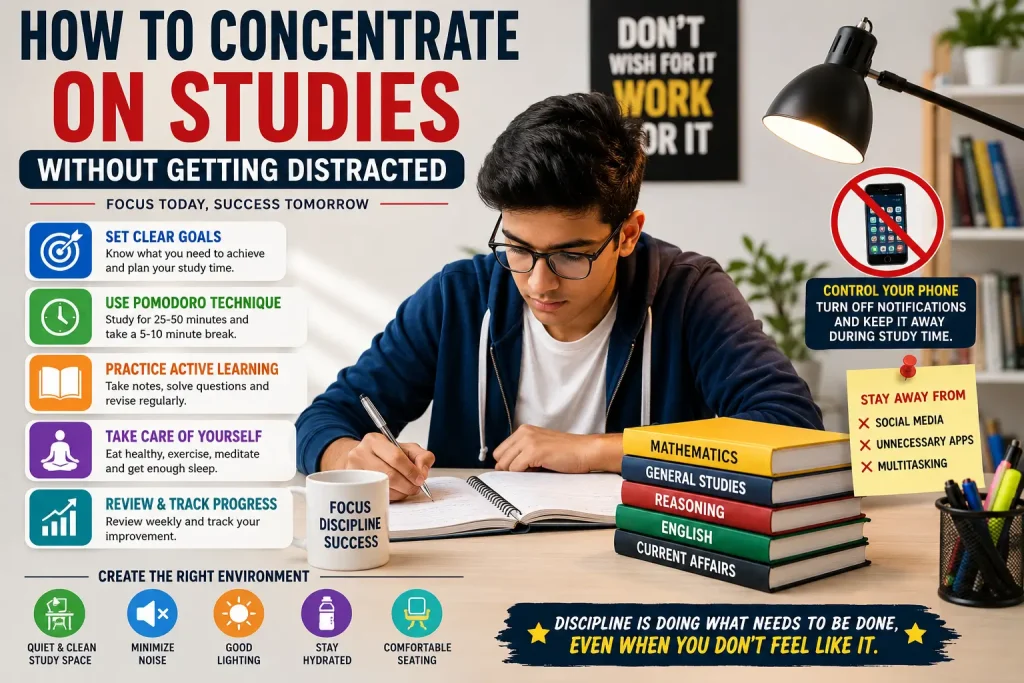
Have you ever opened your book with full motivation, only to find yourself scrolling through Instagram, watching YouTube Shorts, or checking WhatsApp a few minutes later? If yes, you are not alone. Millions of students face the same challenge every day. The good news is that losing focus is not a sign that you are lazy or incapable. It is often the result of an environment filled with digital distractions and poor study habits. Recent research has shown that mobile phone distractions negatively affect learning and memory, making it harder for students to retain information. Studies also suggest that problematic smartphone use is closely linked with reduced well-being and attention control.
The truth is that concentration works like a muscle. The more you train it, the stronger it becomes. Students preparing for competitive exams like SSC, Banking, Railway, UPSC, OSSC, OSSSC, and OPSC need sustained focus because success depends on consistent daily effort rather than occasional bursts of motivation. If your attention keeps jumping from one thing to another, your study hours may look impressive on paper but produce very little real learning.
This guide will help you understand how to focus on studies without getting distracted, how to focus on studies without getting distracted by phone, and how to study without getting distracted using practical techniques backed by modern research and real student experiences.
Why Students Lose Focus While Studying GET YOUR FOCUS HERE
Many students think they cannot concentrate because they lack intelligence. In reality, concentration problems usually come from habits. Every notification, message, or short video trains the brain to expect constant excitement. A textbook cannot compete with the instant rewards provided by social media platforms.
Researchers studying digital distractions have found that mobile phone multitasking creates measurable negative effects on learning performance and memory recall. Educational research also highlights that structured interventions can reduce digital distractions and improve classroom attention.
Think of your brain as a flashlight. When you focus on one subject, the beam is bright and powerful. When you split attention between five different activities, the light becomes weak and scattered. This is exactly what happens when students try to study while chatting, watching videos, and checking notifications.
Another major factor is emotional stress. Fear of exams, comparison with friends, and pressure from family can create anxiety that makes concentration difficult. Sometimes students escape into entertainment because it temporarily reduces stress. Understanding this pattern is the first step toward changing it. Do you looking for Daily routin study plan for your success then click here now
How to Focus on Studies Without Getting Distracted
If you want better concentration, you need a system rather than temporary motivation. Motivation changes every day, but systems create discipline.
Start by setting clear goals. Instead of saying, “I will study mathematics,” decide, “I will complete algebra chapter one and solve twenty questions.” Specific goals keep your mind engaged because you know exactly what success looks like.
The second strategy is to divide study time into smaller blocks. Research and educational experts increasingly recommend focused sessions followed by short breaks because attention naturally declines over time. Purposeful breaks help reduce mental fatigue and improve memory retention.
You should also practice active learning instead of passive reading. Ask yourself questions, explain concepts aloud, solve mock tests, and write short summaries. Active learning forces the brain to participate, making it less likely to wander.
Your study environment matters too. A clean desk, proper lighting, comfortable chair, and minimal noise create a mental signal that it is time to work. Successful students often design an environment where studying is the easiest option available.
How to Focus on Studies Without Getting Distracted by Phone
For most students, the smartphone is the biggest enemy of concentration. The problem is not only the time spent using the device but also the interruption caused by notifications and the temptation to check them.
Recent studies suggest that suppressing phone notifications can significantly improve sustained task engagement for many students. Other research indicates that simply having a phone nearby can increase distraction.
The simplest solution is surprisingly effective:
- Keep your phone in another room.
- Turn on Do Not Disturb mode.
- Log out of social media during study hours.
- Check messages only during planned breaks.
- Use website blockers or focus applications if necessary.
Many students try to rely on willpower, but successful learners reduce temptation instead. If your phone is not within reach, your brain gradually stops expecting constant stimulation.
Create a reward system. Promise yourself that after completing a study session, you can spend ten minutes checking your phone. This turns entertainment into a controlled reward rather than a continuous distraction.
How to Concentrate on Studies Without Any Distractions
A distraction-free study session begins before you even open a book. Planning your day reduces decision fatigue and helps you start working immediately.
Prepare all study materials in advance. Keep textbooks, notes, pens, water, and stationery on your desk. Every unnecessary interruption increases the risk that you will lose focus.
Sleep is another overlooked factor. A tired brain struggles to pay attention and remember information. Balanced nutrition, hydration, and regular exercise also improve cognitive performance. Students often search for magical productivity tricks while ignoring these basic foundations.
Meditation can also help. Even five to ten minutes of mindful breathing each day trains your ability to notice distractions without acting on them. Many top-performing students and professionals use mindfulness techniques because attention is a skill that can be strengthened over time.
Studying with a friend or accountability partner may also improve consistency. When someone else expects you to complete a task, you become less likely to procrastinate.
Daily Habits That Build Long-Term Study Focus
Concentration is built through repeated actions. Small habits practiced every day create powerful results after several months.
Begin your morning without immediately checking social media. Spend the first part of your day planning priorities instead of consuming endless information. Maintain a daily study timetable and try to study at the same hours each day because the brain loves routines.
Review your progress weekly. Ask yourself:
| Habit | Did I Follow It? |
|---|---|
| Studied without phone | Yes/No |
| Completed daily goals | Yes/No |
| Took healthy breaks | Yes/No |
| Slept at least 7 hours | Yes/No |
| Revised previous topics | Yes/No |
Tracking these habits creates awareness and helps identify weak areas before they become major problems.
Remember that consistency beats intensity. Three focused hours every day are more valuable than twelve distracted hours once a week.
Best Study Techniques Used by Toppers to Stay Focused
If you have ever wondered why some students consistently score high marks while others struggle despite studying for long hours, the answer is often not intelligence but concentration. Toppers understand that productive study is far more valuable than simply spending time with books open. They know that one hour of deep, distraction-free learning can outperform three or four hours of interrupted study.
One of the most effective strategies successful students use is the Pomodoro Technique. This method involves studying for 25 to 50 minutes and then taking a short 5 to 10-minute break. The brain naturally works better when it knows that a rest period is coming. Instead of forcing yourself to sit for endless hours, you create a rhythm that keeps your energy levels high throughout the day.
Another powerful technique is active recall. Instead of reading the same chapter repeatedly, close the book and try to remember the important points. Ask yourself questions and answer them without looking at your notes. This method strengthens memory and helps you identify weak areas quickly. Students preparing for SSC, Banking, Railway, UPSC, OSSC, OSSSC, and OPSC exams often use active recall because competitive exams test understanding rather than simple memorization.
The third habit of toppers is revision. Many average students learn a topic once and move on, but successful students revise regularly. They know that forgetting is natural, and revision keeps information fresh in the mind. A simple revision schedule like reviewing topics after one day, one week, and one month can significantly improve long-term retention.
How to Build a Perfect Study Routine Without Getting Distracted
A well-planned study routine reduces confusion and helps you maintain consistency. Without a routine, students often waste valuable time deciding what to study next. A timetable acts like a roadmap, guiding your daily progress.
Start by identifying your most productive hours. Some students concentrate better in the early morning, while others perform best at night. Schedule difficult subjects during your peak energy period and easier tasks during lower-energy hours.
A balanced study schedule might look like this:
| Time | Activity |
|---|---|
| 6:00 AM – 7:00 AM | Revision |
| 7:00 AM – 8:00 AM | Mathematics Practice |
| 10:00 AM – 11:00 AM | Reasoning |
| 2:00 PM – 3:00 PM | General Studies |
| 6:00 PM – 7:00 PM | English |
| 8:00 PM – 8:30 PM | Mock Test Review |
Your timetable should also include short breaks, meals, exercise, and adequate sleep. Studying for sixteen hours without proper rest is rarely sustainable. The goal is to create a routine that you can follow every day for months.
Remember that flexibility is important. If you miss one session, avoid feeling guilty. Simply continue with the next planned task. Consistency over time matters much more than perfection.
How to Avoid Procrastination While Studying
Procrastination is one of the biggest obstacles to academic success. Many students delay studying because the task feels difficult or overwhelming. They tell themselves they will start after watching one video or checking social media for five minutes. Those five minutes often turn into an hour or more.
The easiest way to defeat procrastination is to make the first step incredibly small. Instead of planning to study for five hours, promise yourself that you will study for just ten minutes. Once you begin, momentum usually takes over, and continuing becomes easier.
Breaking large goals into smaller tasks also helps. For example, instead of writing “Complete History,” divide it into:
- Read Chapter One.
- Make short notes.
- Solve 20 MCQs.
- Revise important dates.
Each completed task gives your brain a sense of achievement, increasing motivation to continue.
Another useful strategy is the “two-minute rule.” If a study-related task can be started in less than two minutes, do it immediately. Open the book, organize your desk, or prepare your notes. Small actions reduce resistance and make it easier to enter a focused state.
Foods and Lifestyle Habits That Improve Concentration
Many students underestimate the connection between physical health and mental performance. The brain requires proper nutrition, hydration, and rest to function effectively. If your body lacks energy, maintaining concentration becomes difficult.
A healthy diet rich in fruits, vegetables, nuts, eggs, whole grains, and proteins supports brain health. Drinking enough water is equally important because even mild dehydration can reduce attention and memory performance.
Sleep should never be sacrificed for studying. While staying awake all night may seem productive, research consistently shows that adequate sleep improves learning, memory consolidation, and problem-solving ability. Students should aim for seven to eight hours of quality sleep every night.
Physical exercise is another powerful concentration booster. A simple 20-minute walk, light jogging, yoga, or stretching session increases blood flow to the brain and reduces stress. Regular exercise also improves mood, making it easier to stay motivated during long preparation periods.
Finally, practice gratitude and positive thinking. Negative self-talk such as “I cannot study” or “I will fail” drains mental energy. Replace those thoughts with constructive beliefs like “I improve every day” and “Every study session brings me closer to my goal.” Confidence alone cannot guarantee success, but it creates the mindset needed to stay disciplined.
The journey to mastering how to focus on studies without getting distracted, how to focus on studies without getting distracted by phone, and how to concentrate on studies without any distractions is built on small daily habits. Every distraction you overcome and every productive hour you complete strengthens your ability to learn, achieve higher marks, and move closer to your dream career.
Conclusion
Learning how to concentrate on studies without getting distracted is one of the most valuable skills a student can develop. Intelligence matters, but disciplined attention often separates successful students from average ones. If you can control your environment, manage your phone usage, create a study routine, and practice active learning, your productivity will improve dramatically.
The journey will not be perfect. Some days you will lose focus, procrastinate, or feel unmotivated. That is normal. What matters is returning to your routine instead of giving up.
Your future is built one study session at a time. Every chapter completed, every distraction avoided, and every hour of focused effort brings you closer to your goals.
Frequently Asked Questions
1. How can I focus on studies without getting distracted?
Create a study schedule, remove distractions, keep your phone away, and use active learning methods like solving questions and taking notes.
2. How to focus on studies without getting distracted by phone?
Turn off notifications, use Do Not Disturb mode, keep the device in another room, and check it only during scheduled breaks.
3. Why do I lose concentration after a few minutes?
This often happens because of digital overstimulation, stress, poor sleep, or lack of clear study goals.
4. Which study technique is best for concentration?
The Pomodoro Technique, active recall, and spaced repetition are among the most effective methods.
5. Can meditation improve study focus?
Yes. Regular mindfulness practice can improve attention control and help students manage distractions more effectively.
MOST SEARCHES KEYWORDS ON GOOGLE>how to concentrate on studies without getting distracted
how to focus on studies without getting distracted,
how to focus on studies without getting distracted by phone,
how to study without getting distracted,
how to concentrate on studies without any distractions,
how to concentrate on studies and not get distracted,
how to focus on study without getting distracted,
how to stay focused while studying for long hours,
how to avoid distractions while studying at home,
how to improve concentration in studies naturally,
how to increase focus and concentration for students,
how to study with full concentration,
how to focus on studies for competitive exams,
how to stay focused while preparing for SSC exams,
how to avoid mobile addiction while studying,
best ways to concentrate on studies
tips to improve concentration for students
how to stop procrastinating and start studying
study tips for students to avoid distractions,
how to train your brain to focus on studying,How to Concentrate on Studies Without Getting Distracted,How to Concentrate on Studies Without Getting Distracted,How to Concentrate on Studies Without Getting Distracted,How to Concentrate on Studies Without Getting Distracted,How to Concentrate on Studies Without Getting Distracted,How to Concentrate on Studies Without Getting Distracted,How to Concentrate on Studies Without Getting DistractedHow to Concentrate on Studies Without Getting Distracted,How to Concentrate on Studies Without Getting Distracted
- Why can’t I concentrate on my studies?
- How can I focus on studies without getting distracted?
- How do I stop getting distracted while studying?
- How can I avoid my phone while studying?
- What is the best study technique for concentration?
- How many hours should I study without distraction?
- How can students improve focus naturally?
- How to study for exams without procrastination?
- How to stay motivated while studying every day?
- Does listening to music help concentration while studying?