India’s Petrol Price Hike: What Just Happened, What It Means, and What Comes Next
If you woke up on Friday, May 15, 2026 and headed to your nearest fuel station, you would have noticed something that hadn’t happened in four years — the price board had changed, and not in your favour. The petrol price hike news today ,Petrol price hike news Today 2026 increase has sent shockwaves across households, trucking corridors, political chambers, and commodity markets alike. This wasn’t a rumour circulating on WhatsApp. It wasn’t a speculative social media post. Indian state fuel retailers raised prices of diesel and gasoline on Friday — the first hike in rates in four years. And its implications will ripple through the Indian economy for months to come.
Petrol price hike news Today 2026 increase
The Numbers: What Changed Overnight
Let’s start with the hard facts, because amid all the noise, clarity is what the common citizen needs most.
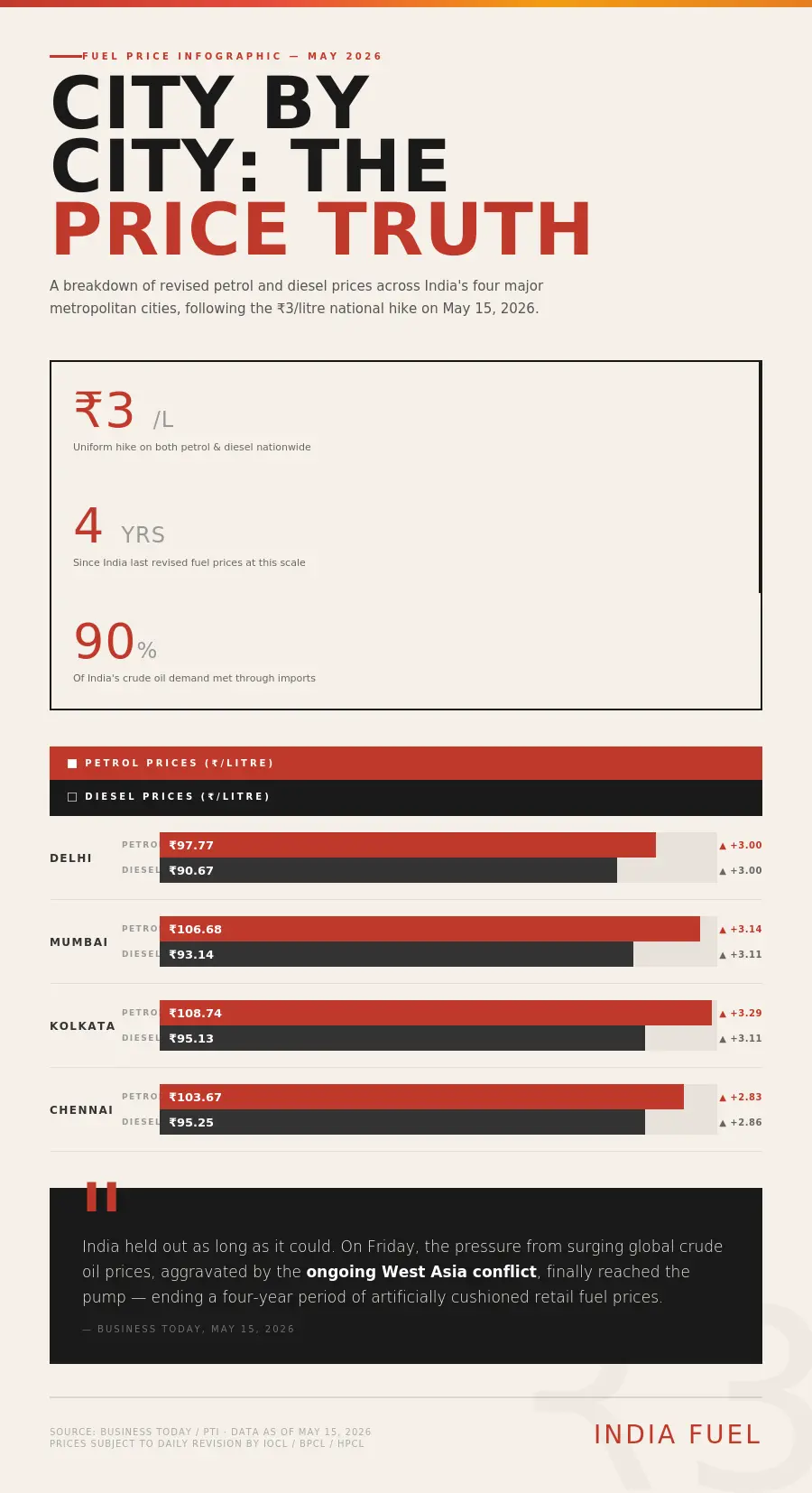
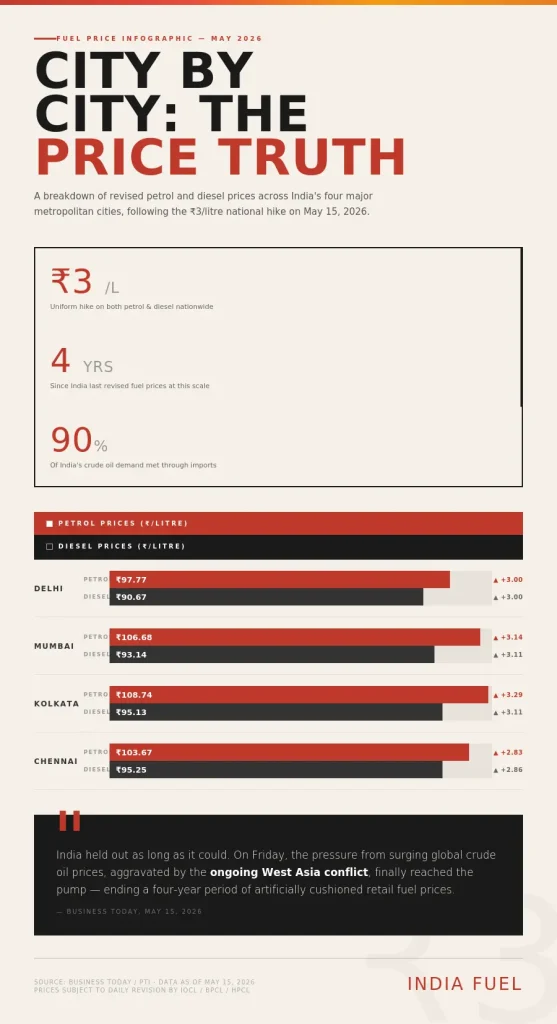
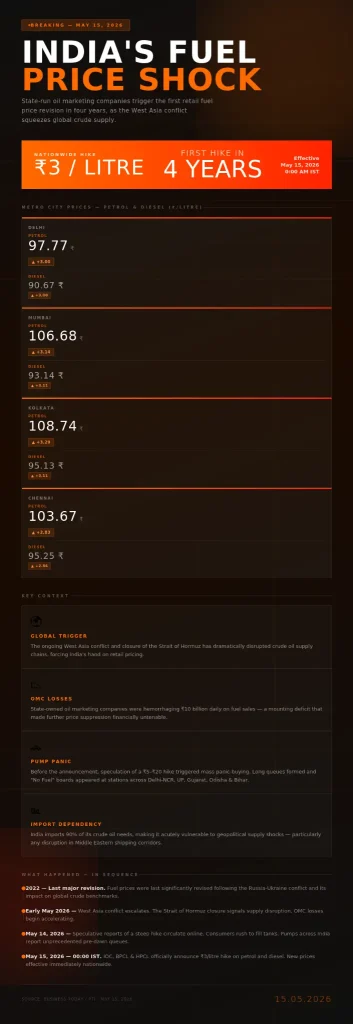
Petrol in Delhi now stands at Rs 97.77 per litre, up from Rs 94.77, while diesel has climbed to Rs 90.67 per litre in the national capital, up from Rs 87.67 previously. These are not trivial increments. A Rs 3-per-litre revision, compounded across millions of daily fill-ups, translates into a substantial macroeconomic perturbation. India TV News
In other cities, the numbers tell a similarly stark story. After state-run oil marketing companies increased petrol and diesel prices by Rs 3 per litre each, petrol climbed to Rs 107.99 per litre and diesel to Rs 93.26 per litre in Jaipur. Mumbai, perpetually among the costliest metros for fuel, continues to record petrol prices in the Rs 107–108 per litre range, driven by higher state taxes and transport costs.
For anyone following petrol price hike news in India, Petrol price hike news Today 2026 increase,this is the kind of seismic revision that demands context, not just a headline.
Why Now? The Geopolitical Undercurrent
The timing of this hike is not coincidental. It is the direct downstream consequence of a severely disrupted global energy supply chain.,Petrol price hike news Today 2026 increase
India raised fuel prices by about 3 percent as the energy crisis driven by the Iran war and closure of the Strait of Hormuz started to bite on the economy. The government announced the Rs 3 per litre price hike as it moved to offset losses triggered by a shortage of supply. India’s geopolitical exposure to Middle Eastern oil routes is a structural vulnerability that policymakers have long acknowledged but struggled to mitigate at speed.
India is the world’s third-largest oil importer, with 90 percent of the oil it consumes coming from overseas. That extraordinary import dependency means that any fracture in global supply logistics — be it a conflict, a naval blockade, or a sanctions regime — translates almost instantaneously into fiscal haemorrhaging for Indian oil marketing companies (OMCs). State-owned retailers, which command 90% of the domestic fuel market, were losing 10 billion rupees daily on fuel sales as the Middle East war continued to squeeze supply.
Ten billion rupees. Every single day. That is not a situation any government, regardless of its political persuasion, can sustain indefinitely.
Decoding the Petrol Price Hike News in Hindi — What the Man on the Street is Saying
For a vast majority of Indians who consume petrol price hike news in Hindi ,Petrol price hike news Today 2026 increase,through regional television channels, vernacular newspapers, and short-form video content, the hike feels deeply personal. A two-wheeler owner in Bhopal, a small-goods transporter in Patna, a cab driver in Hyderabad — for these citizens, a Rs 3 per litre increase is not an abstraction. It is a recalibration of their monthly operating expenses.
Shiromani Akali Dal president Sukhbir Singh Badal said the sharp increase of Rs 3 per litre in petrol and diesel prices, along with a Rs 2 hike in CNG prices, will deliver a crippling blow to the common man, who is already battling inflation and rising living costs.
The political vocabulary has turned combative. AAP, Congress, and SAD attacked the Centre over the petrol and diesel price hike, saying it will deliver an adverse impact on farmers. Opposition benches have converted this fuel revision into a rallying cry. Whether that translates into genuine policy reconsideration or remains performative parliamentary theatre is another question entirely.
Petrol Price Hike News Today in India — The Inflation Equation
One of the most consequential questions arising from this revision is its inflationary trajectory. India’s retail inflation, measured by the Consumer Price Index (CPI), rose to 3.48 per cent in April 2026, up from 3.40 per cent in March. A fuel price revision of this magnitude, coming precisely when inflation had begun exhibiting modest upward creep, raises legitimate concerns about second-order price pressures. Petrol price hike news Today 2026 increase
Consumers will likely experience rising monthly expenses, especially in commuting and logistics-dependent goods. Budget planning becomes more critical as fuel-linked inflation spreads across essential services, and even marginal changes at the pump now carry wider economic consequences.
Food logistics. Last-mile delivery. Public transportation. All these sectors carry embedded fuel costs that, when revised upward, create cascading price increases across the consumer basket. The roti that costs Rs 5 today may cost Rs 6 by July — not because wheat is more expensive, but because the truck that carried the flour paid more at the pump.
That said, industry voices have offered a more measured reading. Industry sources said the price hike appears calibrated enough to partially ease margin pressure on oil companies without creating a major inflationary shock. Whether “calibrated” translates to “painless” for ordinary citizens remains to be seen.
Petrol Price Hike News — Fake or Real? Separating Signal from Noise
In an era of virally transmitted disinformation, every major price revision is accompanied by a cloud of rumour, fabricated screenshots, and manufactured panic. Predictably, social media platforms flooded with claims about impending further hikes, alleged government circulars, and speculative price charts within hours of the announcement.
For those genuinely trying to distinguish petrol price hike news fake or real, Petrol price hike news Today 2026 increase,the answer is unambiguous this time: the Rs 3 per litre hike is entirely real, officially announced, and now fully operational at fuel stations across the country. The revision was confirmed simultaneously by Indian Oil Corporation (IOC), Bharat Petroleum (BPCL), and Hindustan Petroleum (HPCL) — the triumvirate of state-run OMCs that set the pricing benchmark for the nation.
Always verify fuel price changes through official OMC apps or their respective websites before acting on forwarded messages. Panic-buying based on unverified information — as India saw briefly during the early weeks of the COVID crisis — serves no one and often exacerbates the very supply disruptions it fears.
City-Wise Disparity: Why Prices Differ So Dramatically Across India,Petrol price hike news Today 2026 increase
If you’ve ever wondered why petrol costs nearly Rs 10–12 more per litre in Hyderabad than in Delhi, the answer lies in India’s labyrinthine tax architecture. The difference between the cheapest city and the costliest is driven mainly by state VAT structures and transport logistics.
Each state levies its own Value Added Tax (VAT) on fuel, and these rates vary with bewildering heterogeneity. Maharashtra and Andhra Pradesh impose among the highest levies, while Haryana and Delhi have historically maintained comparatively restrained tax structures. This explains why the same commodity, refined in the same refinery, travelling on the same national highway, costs wildly different amounts depending on which side of a state border you fill your tank.
Delhi continues to act as the reference point for fuel pricing trends in India, remaining one of the lowest-priced metros even after the recent Rs 3 hike. petrol price hike news today in idia
Petrol Price Hike News Tomorrow — What the Near-Term Horizon Looks Like,petrol price hke news in india
For consumers anxiously tracking petrol price hike news tomorrow ,Petrol price hike news Today 2026 increaseand beyond, the honest answer is: uncertainty reigns, but further pressure cannot be ruled out.
The future of petrol pricing in India will depend on global oil market trends and government policies regarding taxation. If the Strait of Hormuz disruption persists, if crude oil benchmarks like Brent sustain elevated levels, and if the rupee continues to face depreciation pressure against the dollar, the structural conditions for additional hikes will remain firmly in place.
One analyst noted that the Rs 3 hike in petrol and diesel prices reflects the pressure of elevated global crude oil prices and rising import costs. While the increase may temporarily add to inflation concerns, it could also accelerate the push toward EV adoption and reduced dependence on imported fuel.
That long-term silver lining — the acceleration of India’s electric vehicle transition — is cold comfort for the delivery worker filling up his two-wheeler today. But it does underscore the structural argument that India’s fuel price volatility is, in many ways, a compelling advertisement for energy sovereignty through domestic renewable generation.
The Political Fallout: Calculated Risk or Electoral Liability?
No analysis of petrol price hike news in India ,Petrol price hike news Today 2026 increase is complete without an honest examination of the political calculus. Fuel prices in India have historically been weaponised by both the ruling dispensation and the opposition, deployed strategically in the run-up to elections and quietly revised upward once electoral cycles permit.
Hours after the hike, Samajwadi Party chief Akhilesh Yadav took a swipe at Prime Minister Narendra Modi’s call to conserve fuel, seemingly emphasising that his party alone can offer a path of development. Political parties across the spectrum have been swift to capitalise on public discontentment.
The government, for its part, appears to have made a calculated bet: absorbing the political opprobrium of a necessary revision now rather than allowing OMC losses to metastasize into a full-blown subsidy crisis.
Conclusion: Brace, But Also Plan
The petrol price hike India witnessed on May 15, 2026 is real, consequential, and embedded in forces that extend far beyond any single government’s discretion. It is the product of geopolitical fracture, import dependency, fiscal compulsion, and the perennial tension between consumer welfare and market sustainability.Petrol price hike news Today 2026 increase
The fuel market has shifted from stability to sensitivity, and even small global shocks are now quickly reflected in domestic retail prices — marking a transition toward more market-linked pricing behavior across India’s energy ecosystem. The Sunday Guardian
What you can do is plan ahead. Consolidate trips. Explore carpooling. Track fuel consumption. And stay informed — from credible sources, not forwarded screenshots. In an age of information overload, the most empowering thing any citizen can do is know the difference between noise and fact.
The pump price has changed. How India responds — individually, collectively, and politically — will define the conversation for months ahead.
India’s Four-Year Fuel Freeze Breaks: What the Rs 3 Petrol & Diesel Hike Really Means for You
On May 15, 2026, something changed at petrol stations across India that hadn’t happened in four years. Quietly, without fanfare, the price boards were updated. Petrol and diesel prices were hiked by Rs 3 per litre across the country, ending a period of relative stability that had kept retail fuel prices largely insulated from global volatility. Business Today
For millions of ordinary Indians — the commuter, the cab driver, the corner shop owner — that single line carries enormous weight.
The Numbers That Matter
The revision was uniform in its direction, but varied in its intensity across cities. In Delhi, petrol moved from Rs 94.77 to Rs 97.77 per litre, while diesel rose from Rs 87.67 to Rs 90.67. Across other metros, increases ranged between Rs 2.83 and Rs 3.29 per litre, with petrol now priced at Rs 108.74 in Kolkata, Rs 106.68 in Mumbai, and Rs 103.67 in Chennai. Diesel climbed too — Kolkata at Rs 95.13, Mumbai at Rs 93.14, and Chennai at Rs 95.25 per litre. Business Today
These are not inconsequential figures. Multiply Rs 3 across a full tank, across millions of vehicles, across every delivery truck and autorickshaw in the country — and the macroeconomic footprint becomes substantial almost immediately.
Panic Before the Announcement
Perhaps more telling than the numbers themselves was the public response before the revision was even official. Even before the official announcement, reports of a possible steep hike had already sent consumers rushing to petrol stations across the country. Long queues formed at outlets, and “No Fuel” boards went up at several pumps as stations struggled to keep up with the sudden surge in demand. Many consumers opted for full-tank refills, fearing prices could climb further, with speculation circulating that rates might rise by anywhere between Rs 5 and Rs 20 per litre. Business Today
That visceral, preemptive panic is itself a data point. It reflects a deep-seated public wariness about fuel pricing — a mistrust born from years of watching prices creep upward, often without warning or adequate explanation.
An India Today ground report covering 15 petrol pumps across Delhi-NCR, Uttar Pradesh, Gujarat, Odisha, and Bihar captured the scale of the anxiety: unusually high footfall, hurried fill-ups, and a palpable sense that this revision may not be the last. Business Today
That final phrase is the one that should stay with consumers. May not be the last. It is a quiet but significant caveat.
The Bigger Picture: Why This Happened Now
This hike did not emerge in a vacuum. The West Asia conflict and its chokehold on global crude supply chains has been the underlying pressure building for months. India, structurally dependent on imported oil for the overwhelming majority of its energy needs, was always going to absorb the shock eventually. The Rs 3 revision is the government and state-run oil marketing companies finally acknowledging that the cushion had run out.
The broader implication is one of structural fragility. India’s retail fuel pricing, despite its domestic political management, is ultimately tethered to geopolitical events thousands of kilometres away — events over which the government has no control whatsoever.
What Comes Next
The Rs 3 hike is described as a measure to partially offset mounting losses at state-owned fuel retailers — but it is unlikely to be the end of the story. Consumer budgets will feel the squeeze first in commuting, then in food logistics, and eventually across the broader consumer basket as transport costs filter through supply chains.
The more important signal, however, is this: India’s era of artificially stable retail fuel prices — insulated from global volatility through subsidy and political calculation — appears to be giving way to a more reactive, market-sensitive pricing environment. For household budget planning, that shift demands attention.
Source: Business Today / PTI, May 15, 2026. All figures are effective from May 15, 2026 and are subject to daily revision by oil marketing companies
All prices mentioned are as of May 15, 2026. Fuel rates are subject to daily revision by oil marketing companies. Always verify current prices through official IOCL/BPCL/HPCL platforms.Petrol price hike news Today 2026 increase